The chemistry pairing scheme 2nd year 2026 plays a decisive role in shaping how students attempt their board exams. It is not just about what to study, but how different chapters are connected in the paper. Understanding this pairing pattern turns random preparation into a focused, high-scoring strategy.
Examiners design the paper in a way that blends conceptual understanding with selective choice. Instead of covering everything equally, the scheme groups chapters so that students can attempt questions with flexibility. This means a strong grip on selected chapters can still help secure excellent marks.
A clear class 12 paper pattern emerges when observing recent trends. Physical chemistry, organic chemistry, and inorganic chemistry are all interlinked through pairing. Short questions, long questions, and numerical problems are distributed in a balanced way, ensuring that students cannot rely on just one section.
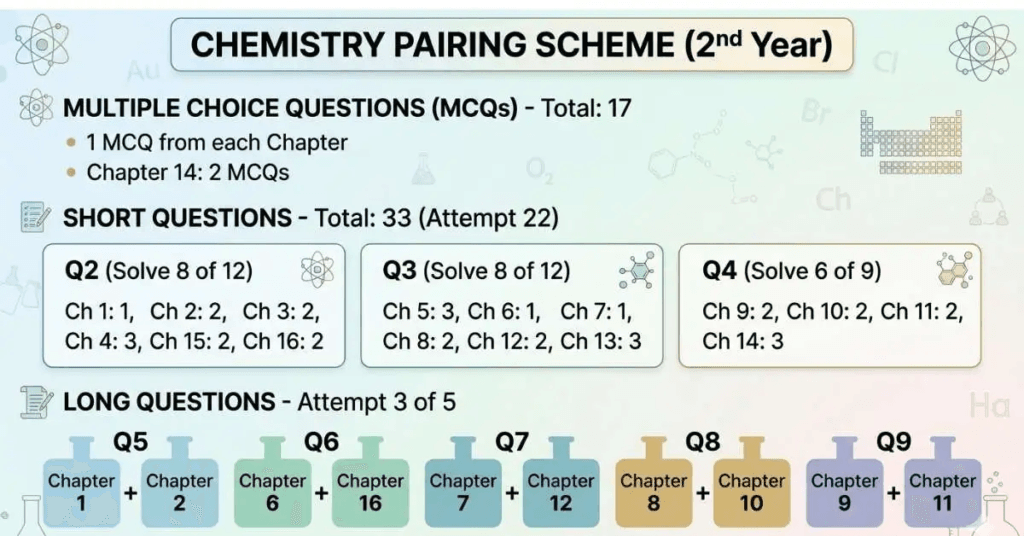
Multiple Choice Questions (MCQs) – Objective Section
| Section | Chapter Coverage | Expected MCQs |
|---|---|---|
| MCQs | All Chapters | 1 MCQ from each chapter |
| MCQs | Chapter 14 | 2 MCQs |
In the objective part, MCQs are expected from all chapters to ensure complete syllabus coverage. However, students should give special attention to Chapter 14, as two MCQs are likely to appear from this chapter, while one MCQ is expected from each remaining chapter. Therefore, revising Chapter 14 thoroughly can give you an edge.
Short Answer Questions – Subjective Section
Question No. 2 (Attempt 8 out of 12)
| Chapter | No. of Questions |
|---|---|
| Chapter 1 | 1 |
| Chapter 2 | 2 |
| Chapter 3 | 2 |
| Chapter 4 | 3 |
| Chapter 15 | 2 |
| Chapter 16 | 2 |
This question mainly focuses on early and concluding chapters. The expected chapter-wise distribution is given below:
- Chapter 1: 1 question
- Chapter 2: 2 questions
- Chapter 3: 2 questions
- Chapter 4: 3 questions
- Chapter 15: 2 questions
- Chapter 16: 2 questions
Hence, students should prepare numerical problems and definitions from these chapters carefully.
Question No. 3 (Attempt 8 out of 12)
| Chapter | No. of Questions |
|---|---|
| Chapter 5 | 3 |
| Chapter 6 | 1 |
| Chapter 7 | 1 |
| Chapter 8 | 2 |
| Chapter 12 | 2 |
| Chapter 13 | 3 |
This section emphasizes mid-syllabus chapters with both conceptual and numerical content.
- Chapter 5: 3 questions
- Chapter 6: 1 question
- Chapter 7: 1 question
- Chapter 8: 2 questions
- Chapter 12: 2 questions
- Chapter 13: 3 questions
As a result, balanced preparation of theory and reactions is highly recommended.
Question No. 4 (Attempt 6 out of 9)
| Chapter | No. of Questions |
|---|---|
| Chapter 9 | 2 |
| Chapter 10 | 2 |
| Chapter 11 | 2 |
| Chapter 14 | 3 |
This question usually contains analytical and application-based short questions.
- Chapter 9: 2 questions
- Chapter 10: 2 questions
- Chapter 11: 2 questions
- Chapter 14: 3 questions
Therefore, Chapter 14 again proves to be very important in the short-question section.
Long Answer Questions – Extensive Section
| Question No. | Chapter Pair |
|---|---|
| Q.No.5 | Chapter 1 OR Chapter 2 |
| Q.No.6 | Chapter 6 OR Chapter 16 |
| Q.No.7 | Chapter 7 OR Chapter 12 |
| Q.No.8 | Chapter 8 OR Chapter 10 |
| Q.No.9 | Chapter 9 OR Chapter 11 |
The long questions are generally paired from two chapters. Students should prepare at least one chapter fully from each pair.
- Question No. 5: Chapter 1 OR Chapter 2
- Question No. 6: Chapter 6 OR Chapter 16
- Question No. 7: Chapter 7 OR Chapter 12
- Question No. 8: Chapter 8 OR Chapter 10
- Question No. 9: Chapter 9 OR Chapter 11
Consequently, selective but in-depth preparation can significantly boost exam performance.
Understanding the Paper Structure for 2nd Year Chemistry
The paper is divided into multiple sections, each testing a different level of understanding. Objective questions focus on quick recall, while subjective parts require deeper explanations and derivations.
Short questions usually come from almost every chapter, but long questions follow a pairing scheme. This is where strategy matters most. Instead of memorizing all chapters equally, smart preparation involves identifying high-weightage chapters and their pair combinations.
Numerical problems and conceptual reasoning dominate physical chemistry. Organic chemistry requires reaction mechanisms and conceptual clarity. Inorganic chemistry focuses more on theory and periodic trends. The pairing scheme ensures that at least one option in every question aligns with each of these areas.
Chapter-Wise Pairing Distribution for 2026
The chemistry pairing scheme 2nd year 2026 reflects a structured combination of chapters. Some chapters are frequently paired due to conceptual similarities, while others are grouped to balance difficulty levels.
Physical chemistry chapters often appear together in numerical-based questions. Topics like chemical equilibrium, thermodynamics, and electrochemistry are commonly paired because they demand analytical thinking.
Organic chemistry chapters usually form pairs involving reaction mechanisms and synthesis. These questions test clarity rather than memorization. A student with strong concepts can attempt these confidently even with limited preparation.
Inorganic chemistry chapters are paired to test theoretical knowledge. These questions are relatively direct but require precise understanding of concepts like periodic properties and bonding theories.
High-Scoring Strategy Based on Pairing Scheme
A random study approach rarely works for chemistry. The pairing scheme demands selective preparation with depth instead of surface-level coverage of all chapters.
Focusing on chapters that frequently appear in long questions can significantly increase scoring potential. Preparing one chapter from each pair ensures that at least one option in the exam feels comfortable.
Time management also improves when preparation aligns with the pairing scheme. Instead of wasting hours on low-weightage topics, effort is directed toward areas that are more likely to appear in important sections.
Practicing past papers according to the pairing pattern sharpens accuracy. It builds confidence and helps in identifying repeated concepts, which often reappear with slight variations.
Importance of Conceptual Clarity in Chemistry Paper
The pairing scheme is designed to reward understanding, not cramming. Questions are often twisted to test application rather than direct recall.
Students who rely only on memorization struggle when questions are framed differently. On the other hand, those who understand the logic behind reactions, formulas, and principles can adapt easily.
Organic chemistry especially demands this approach. Reaction mechanisms cannot be memorized effectively without understanding electron movement and bonding changes. Similarly, physical chemistry requires clarity in formulas and their applications.
Smart Preparation Approach for 2026 Exams
Preparation becomes more effective when it follows a structured path aligned with the pairing scheme. Instead of jumping between chapters, building a sequence based on pairing combinations saves time and energy.
Start with strong chapters. Then move to paired chapters that complement them. This creates a safety net in the exam, ensuring that at least one question from each pair can be attempted confidently.
Revision should also follow the same pattern. Reviewing paired chapters together strengthens connections between concepts and improves retention. It also helps in recalling information quickly during the exam.
Consistency matters more than intensity. Even short, focused study sessions aligned with the pairing scheme can produce better results than long, unplanned hours.
How Pairing Scheme Impacts Final Marks
Marks are not just about how much is written, but how effectively questions are attempted. The pairing scheme directly influences this by offering choices.
Students who understand the scheme make smarter decisions in the exam hall. They skip difficult questions without panic and attempt those aligned with their preparation.
This reduces stress and increases accuracy. Instead of guessing or forcing answers, students write with confidence, which improves presentation and overall scoring.