The Mathematics 1st Year Pairing Scheme 2026 has become a key focus for students aiming to prepare strategically for their exams instead of studying everything randomly. It gives a clear idea of how questions are distributed, which chapters are grouped together, and how examiners design the paper.
Instead of wasting time on guesswork, students can now shape their preparation around actual paper patterns. This approach doesn’t just save time, it also improves accuracy during exams when pressure is high and every mark matters.
Mathematics in 1st year is not about memorizing—it’s about understanding concepts and applying them in structured questions. That’s exactly where 1st year pairing schemes make a real difference.
Math Class 11 Pairing Scheme 2026
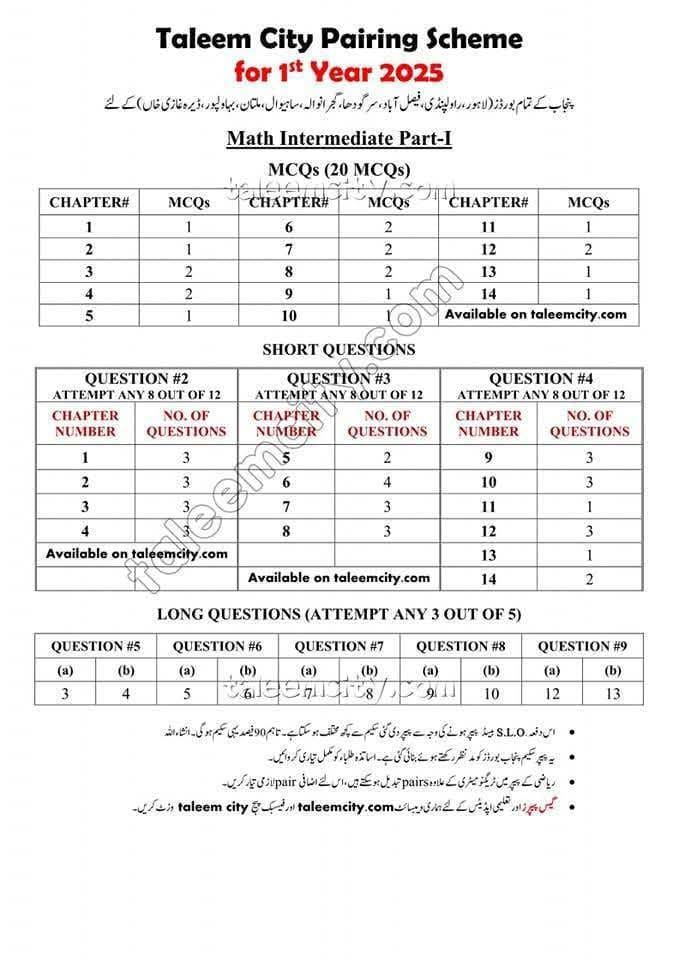
Paper Scheme Instead of Random Study Approach
The real advantage of studying through the Math 1st Year Pairing Scheme 2026 is that it helps in identifying how the paper is constructed from different chapters. Instead of treating each chapter separately, students start seeing connections between topics.
This shift in thinking is powerful. When you know which chapters are linked in exam questions, preparation automatically becomes more focused and result-oriented.
Most exam papers are not random collections of questions. They follow a structured design that balances conceptual questions, numerical problems, and application-based exercises. Once students understand this structure, preparation becomes smoother and less stressful.
Even difficult topics feel manageable when they are studied in the right combination rather than isolation.
How Pairing Scheme Shapes Your Study Direction
Mathematics is a subject where practice matters more than reading theory again and again. But practicing without direction can waste valuable time.
The pairing scheme helps in setting that direction. It highlights how chapters are connected in exam questions, which allows students to prepare in pairs or groups of related topics instead of single-topic isolation.
For example, algebra-based sections often connect with equations and expressions, while trigonometric parts may appear with angle-based applications. Recognizing these patterns builds confidence during revision.
Students who follow this approach often notice that their speed improves because they are not switching between unrelated topics repeatedly.
Smart Focus Areas Inside Math 1st Year Exam Structure
Every paper has certain zones where questions are repeated in different forms. The Math 1st Year Pairing Scheme 2026 helps in identifying these repeating zones so preparation becomes sharper.
Instead of covering everything equally, attention naturally shifts toward high-impact areas. These areas usually carry a mix of conceptual understanding and problem-solving ability.
Some parts of the syllabus demand step-by-step logical solving, while others require quick formula-based answers. Knowing this difference is essential for scoring better marks under time pressure.
When preparation is aligned with exam design, even moderate preparation can lead to strong results.
Why Students Struggle Without Pairing Scheme Awareness
A common issue among students is studying chapters in a random order. This leads to confusion when the actual exam paper feels different from expectations.
Without understanding the pairing structure, students often over-focus on one section while ignoring connected topics. This imbalance becomes visible during the exam when linked questions appear from different chapters.
Another challenge is time management. Students who don’t follow a structured approach usually spend too much time on difficult chapters and less on scoring areas.
The pairing scheme removes this confusion by giving a roadmap of how to distribute preparation time more effectively.
Concept-Based Learning Becomes Easier with Structured Preparation
Mathematics is not a subject where memorization alone works. It requires logic, steps, and consistency.
When students follow the Math 1st Year Pairing Scheme 2026, they naturally start studying concepts in a connected way. This improves retention because the brain understands relationships between topics instead of isolated facts.
Problem-solving also becomes faster. When similar types of questions appear from linked chapters, students recognize patterns quickly and apply known methods without hesitation.
This kind of learning is far more effective than last-minute preparation or selective study.
Exam Confidence Improves with Pattern Awareness
Confidence during exams is not just about preparation—it is about familiarity with structure.
When students know how questions are likely to appear, panic reduces automatically. Instead of facing surprises, they already expect the pattern.
This mental readiness plays a major role in performance. Even if a question seems slightly different, familiarity with the structure helps in breaking it down step by step.
That’s why students who prepare through pairing schemes often feel more stable during exams compared to those who rely only on textbooks.
Time Management Becomes More Controlled and Practical
One of the biggest advantages of using the pairing scheme is better time management during preparation.
Instead of spending equal time on all chapters, students start dividing time based on importance and linkage. Some sections need deeper practice, while others only need revision and formula recall.
This balanced approach prevents burnout. Study sessions become shorter but more effective because every session has a clear purpose.
Even revision becomes more organized since chapters are already grouped in a logical flow.
Final Focus During Revision Stage
When exams come closer, revision strategy becomes more important than new learning. At this stage, the Math 1st Year Pairing Scheme 2026 acts like a revision map.
Students can quickly revisit linked chapters together, which strengthens memory and reduces confusion. Solving past-style questions within paired topics also helps in improving speed.
Instead of reading everything again, revision becomes targeted and efficient, focusing only on what matters most in the exam context.