1st Year Economics Pairing Scheme 2026
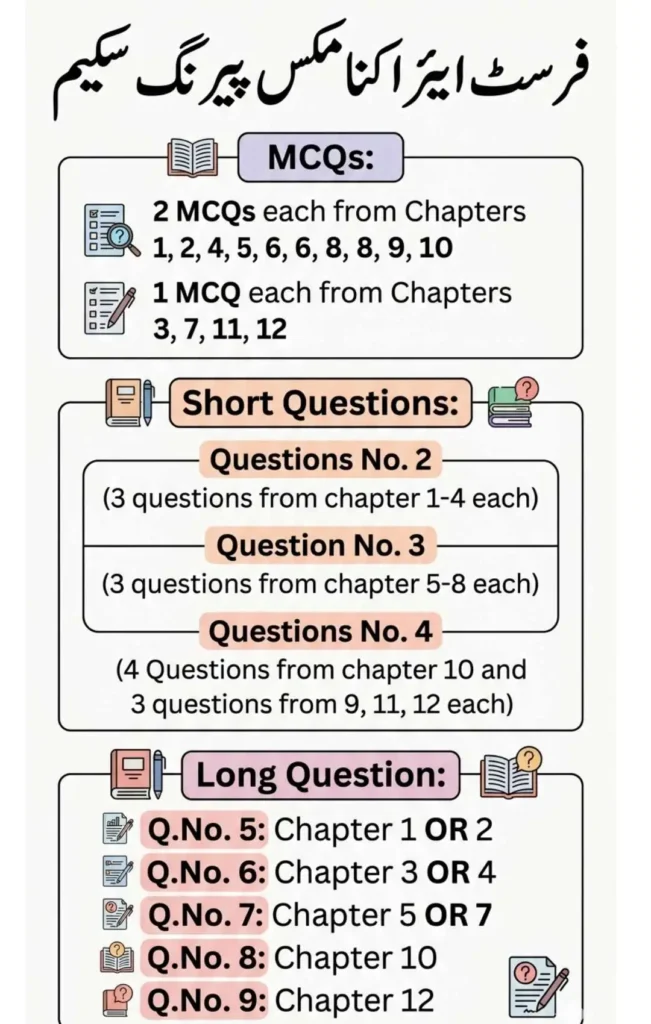
The pairing scheme is given below:
MCQs:
- 2 MCQs from chapters 1, 2, 4, 5, 6, 8, 9, 10 each
- 1 MCQs from chapters 3, 7, 11, 12 each
Short Questions
- Question No. 2: (3 questions from chapter 1-4 each)
- Question No. 3: ( 3 questions from chapter 5-8 each)
- Question No. 4: (4 Questions from chapter 10 and 3 questions from 9, 11, 12 each)
Long Question:
- Question No. 5: Chapter 1 OR 2
- Question No. 6: Chapter 3 OR 4
- Question No. 7: Chapter 5 OR 7
- Question No. 8: Chapter 10
- Question No. 9: Chapter 12
You may also see: Class 11 Economics Guess Papers
Students preparing for board exams should also check the complete 11th Class paper scheme for all subjects including Physics, Chemistry, and English to understand full paper patterns, and combine it with 1st Year Guess Paper preparation for better exam practice and repeated question coverage that helps improve overall marks in FA, FSC, ICS & ICOM Part 1 exams.
The Economics pairing scheme 2026 Class 11 Punjab Board clearly shows MCQs distribution, short questions selection, and long questions pairing so students can focus only on high-weightage areas. This makes exam preparation more predictable and improves scoring chances in less time.
For students of Class 11 (HSSC Part 1), the 11th Class Economics pairing scheme 2026 PDF is not just a guide but a complete exam strategy that highlights repeated questions, important chapters, and most expected paper patterns from Punjab Boards.
11th Class Economics Pairing Scheme 2026 Punjab Board Paper Pattern
The official-style Economics pairing scheme 2026 1st year Punjab Board is based on board paper structure:
- MCQs from all major chapters (concept-based questions)
- Short questions grouped chapter-wise with internal pairing
- Long questions divided into selective attempt pattern
- Important numerical and theory-based topics included
This structure helps students understand exactly how the paper will be set in the 2026 exam.
Chapter Wise Pairing Scheme Economics 1st Year 2026
The 1st Year Economics pairing scheme 2026 PDF Punjab Board usually gives priority to high-frequency chapters such as:
- Introduction to Economics (basic definitions & concepts)
- Demand and Supply (most repeated theory questions)
- National Income (numerical + conceptual MCQs)
- Banking System (short questions focus area)
- Inflation & Economic Problems (long questions expected)
These chapters carry strong exam weightage and are repeatedly tested in board papers.
MCQs Distribution in Economics Pairing Scheme 2026
In the Economics 1st year pairing scheme 2026, MCQs are taken from:
- Basic definitions from every chapter
- Key terms and concepts
- Graph-based and simple analytical questions
- Important numerical formulas
MCQs preparation becomes easier when students follow the pairing scheme instead of full-book revision.
Short Questions Pairing in 1st Year Economics 2026
The short questions in Economics pairing scheme 2026 Punjab Board are arranged in pairs from selected chapters. Students are usually required to:
- Attempt grouped short questions
- Focus on repeated board questions
- Prepare selective chapters instead of whole book
This section is where most students gain marks quickly.
Long Questions Selection Pattern
The 1st year Economics pairing scheme 2026 PDF download also explains long question selection:
- Only selected long questions appear in exam
- Usually 2–3 chapters are paired for long answers
- Conceptual + theoretical questions are repeated
This helps students prepare targeted answers instead of full syllabus memorization.
Why Economics Pairing Scheme 2026 is Important
The Punjab Board 1st Year Economics pairing scheme 2026 is important because:
- It reduces syllabus pressure
- Helps in smart exam preparation
- Increases chances of high marks
- Saves revision time before exams
- Gives clear idea of paper structure
How to Use 1st Year Economics Pairing Scheme for High Marks
To get maximum benefit from the Economics 1st year pairing scheme 2026 PDF, students should:
- Start preparation from high-weight chapters first
- Practice past papers using pairing pattern
- Focus MCQs daily for revision
- Memorize repeated short questions
- Revise long questions with understanding