The 1st Year Computer Pairing Scheme 2026 is one of the most searched resources among students preparing for the annual examinations. It helps students understand the paper pattern, chapter-wise distribution of questions, and the areas that carry greater weight in the examination. By following the latest pairing scheme, students can prepare more effectively and improve their chances of achieving higher marks.
The Computer Science pairing scheme for 1st year 2026 provides a clear overview of how objective, short, and long questions are arranged in the examination paper. Students can use this information to focus on important chapters while ensuring complete syllabus coverage.
Students looking for the latest 1st year pairing scheme can access subject-wise paper schemes to understand the exam pattern and chapter distribution. These pairing schemes help students prepare smartly by highlighting important topics and providing a clear roadmap for effective exam preparation across all intermediate subjects.
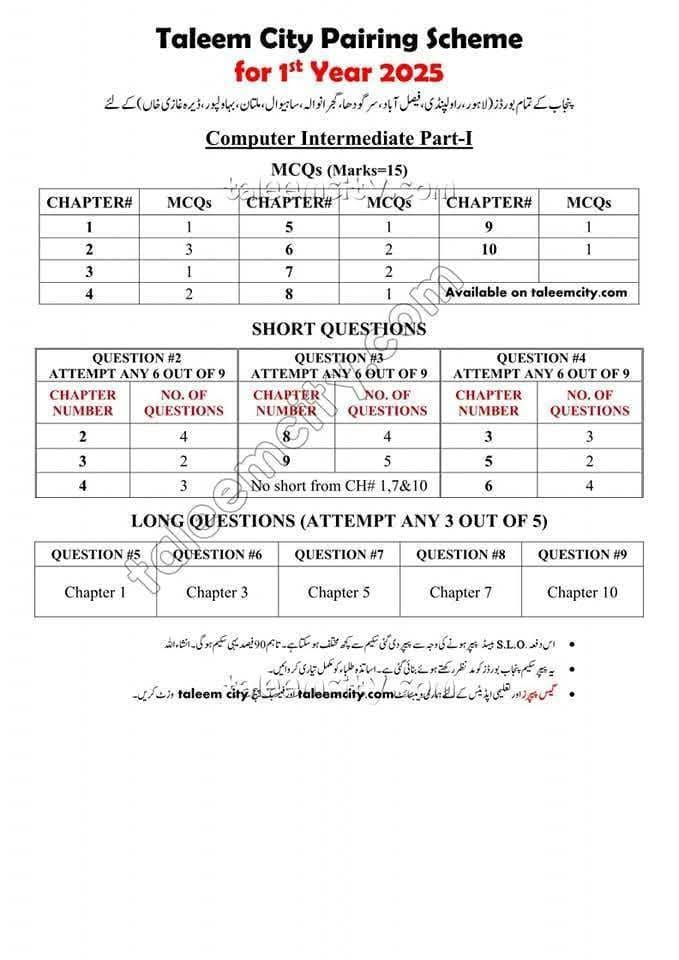
For students searching for the FSc Computer Science pairing scheme 2026, 11th class Computer paper scheme, or Computer Science paper pattern 2026, understanding the latest paper structure can make exam preparation more organized and less stressful.
Computer Science Paper Pattern for 1st Year 2026
The exam pattern is designed to test both conceptual clarity and practical understanding. Computer Science at this level is not just theory memorization; it connects logic, programming basics, and problem-solving ability.
The paper usually reflects three core sections:
- Objective type questions focusing on concepts and definitions
- Short questions that test understanding of core topics
- Long questions that require detailed explanations and structured answers
The pairing scheme helps identify which topics are frequently combined in short and long questions, making preparation more focused and less time-consuming.
How Pairing Scheme Shapes Your Study Strategy
Instead of treating every chapter equally, the pairing system highlights connections between important topics. This creates a pattern where certain concepts repeatedly appear together in exam questions.
For example, theoretical foundations often link with practical logic-based questions. Programming fundamentals are usually connected with algorithm-style explanations. This structure builds a predictable pattern that students can use to plan revision smartly.
When preparation aligns with pairing trends, revision becomes sharper, and unnecessary content load reduces automatically.
Chapter-Based Question Distribution Insight
Computer Science 1st Year paper design generally follows a balanced distribution of chapters. However, not every chapter carries the same question weight.
Some chapters are repeatedly used in:
- MCQs section for direct concept checking
- Short questions for explanation-based testing
- Long questions for detailed reasoning or coding logic
This layered distribution helps exam setters evaluate understanding from multiple angles instead of memorization alone. Students who recognize these patterns often perform better under time pressure.
MCQs Pattern in Computer Science Paper 2026
MCQs are not random in nature. They are carefully picked from core definitions, key terms, and fundamental programming concepts. Many MCQs repeat conceptual themes like logic gates, data types, system basics, and flow of execution.
The pairing scheme indirectly helps predict MCQ focus areas because repeated pairing topics often become MCQ favorites. This makes revision more targeted and efficient.
Short Questions and Their Hidden Connection Pattern
Short questions usually come from interconnected topics rather than isolated concepts. One chapter may support another in question formation, creating a linked structure across the syllabus.
These questions often test clarity of explanation, not just memorized definitions. A strong understanding of topic relationships makes it easier to handle this section confidently.
Long Questions Strategy Based on Pairing Trends
Long questions demand detailed writing, diagrams, or step-by-step explanations. The pairing scheme reveals which topics are commonly expanded into long questions.
Instead of preparing everything equally, focusing on high-frequency paired topics improves answer quality and saves revision time. These questions often combine theory with applied logic, especially in programming-related chapters.
Smart Revision Approach Using Pairing Scheme
A structured revision approach always performs better than scattered study habits. The pairing scheme naturally creates a revision roadmap where topics are studied in connected groups instead of isolation.
This method improves memory retention and helps in recalling answers faster during exams. It also reduces confusion when similar concepts appear in different sections of the paper.