Chemistry 1st Year Pairing Scheme 2026 is becoming one of the most searched topics among intermediate students who want a clearer direction for exam preparation. When the paper pattern feels uncertain, understanding how chapters are paired with objective, short, and long questions can change the entire study approach. Instead of memorizing everything blindly, students start focusing on what actually matters in the exam.
This pairing scheme is not just about guessing questions. It reflects how examiners balance conceptual understanding with numerical problem-solving and factual recall. Chemistry at this level is built around logical connections, and the pairing system highlights those connections in a structured way. Once the pattern becomes familiar, preparation turns more focused and less stressful.
Many students overlook the importance of understanding question distribution. Yet, this is exactly where marks are decided. A smart preparation strategy begins when the Chemistry 1st Year Pairing Scheme 2026 is properly understood and used as a roadmap rather than a prediction sheet.
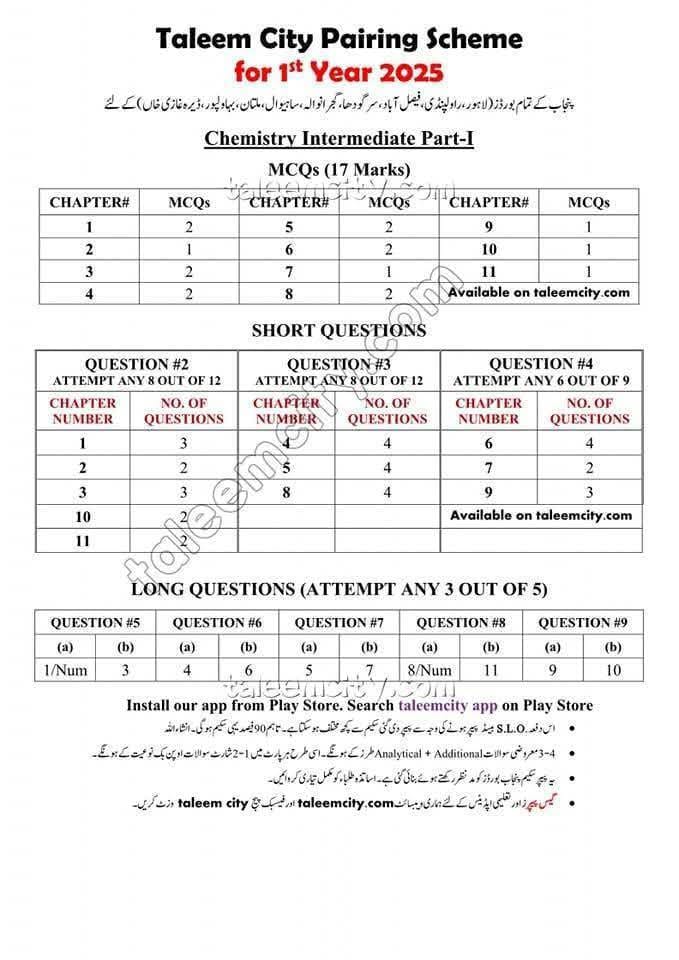
Understanding the Core Structure Behind the Pairing Scheme
The Chemistry paper at the 1st year level is designed around a balanced mix of conceptual theory, numerical problems, and factual recall. The pairing scheme connects specific chapters with expected question types so students can predict the pattern, not the exact questions.
Instead of studying each chapter in isolation, the scheme encourages linked preparation. For example, some chapters are repeatedly paired in short questions because they share similar chemical concepts, while others are frequently used in numerical-based long questions.
This structure helps reduce uncertainty. It gives a direction where effort should be concentrated, especially when time is limited.
MCQs Pattern and Conceptual Focus
Multiple Choice Questions form the first section of the paper and often test clarity of concepts rather than lengthy explanations. The pairing scheme highlights repeated MCQ areas, especially from:
- Basic definitions and terminologies
- Periodic table trends and properties
- Chemical bonding concepts
- Fundamental laws and formulas
MCQs are not random. They usually come from repeated conceptual zones. A strong grip on these areas can quickly improve overall score, even without deep preparation of every chapter.
Speed and accuracy matter more than length of study here. One concept can appear in different forms, so understanding logic behind reactions and formulas is more effective than memorization.
Short Questions Distribution and Repeated Pairings
Short questions in Chemistry are often where the pairing scheme becomes most useful. Certain chapters are frequently combined in exam papers, forming predictable clusters of short answers.
These questions usually focus on:
- Reaction explanations in simple form
- Definitions with slight variations
- Small derivations or formula-based answers
- Basic numerical conversions
The pattern shows that conceptual chapters are often paired with application-based topics. This creates a balance between theory and practice in the paper.
Students who understand these combinations can prepare smarter notes instead of reading everything equally. It reduces revision time and increases recall efficiency during exams.
Long Questions Selection and High-Weight Areas
Long questions carry the most marks and require structured preparation. The pairing scheme often highlights which chapters are more likely to appear together in this section.
These questions usually come from:
- Chemical equilibrium and its applications
- Thermochemistry and energy changes
- Electrochemistry basics and calculations
- Organic chemistry reactions and mechanisms
Long questions are rarely isolated. A single question may combine two related concepts from different chapters. That is where pairing becomes important because it shows how topics are interconnected.
Writing practice matters here. Even strong concepts can lose marks if presentation is weak or steps are missing in numerical solutions.
Chapter Interconnection and Study Flow Logic
Chemistry is not a subject of isolated chapters. It works as a continuous chain of concepts. The pairing scheme reflects this flow by linking earlier topics with advanced ones.
For example, atomic structure concepts naturally support chemical bonding, while bonding concepts later connect with reaction mechanisms. Similarly, energy changes lead into equilibrium understanding.
This flow helps in building a layered understanding. When chapters are studied in connected form, revision becomes faster and memory retention improves without extra effort.
Exam Preparation Strategy Based on Pairing Pattern
A smart preparation approach does not depend on studying everything equally. The pairing scheme helps in dividing focus areas into priority zones.
High-frequency topics need deeper attention, while low-frequency areas require only conceptual clarity. Revision becomes more structured when chapters are grouped according to their pairing behavior.
Practice also becomes more targeted. Instead of solving random questions, students can focus on grouped past paper patterns, which increases familiarity with real exam structure.
Time management plays a key role here. Understanding which sections carry more weight allows better planning during revision days.
Concept Clarity Over Rote Learning
Chemistry at this level is designed to test understanding rather than memorization. The pairing scheme indirectly supports this idea by linking related concepts across chapters.
When a student understands why two topics are often paired, it becomes easier to remember both. Logical connections replace rote learning, making preparation more stable under exam pressure.
Even difficult numerical problems become manageable when the underlying concept is clear. This is where consistent practice combined with pattern awareness creates real improvement.