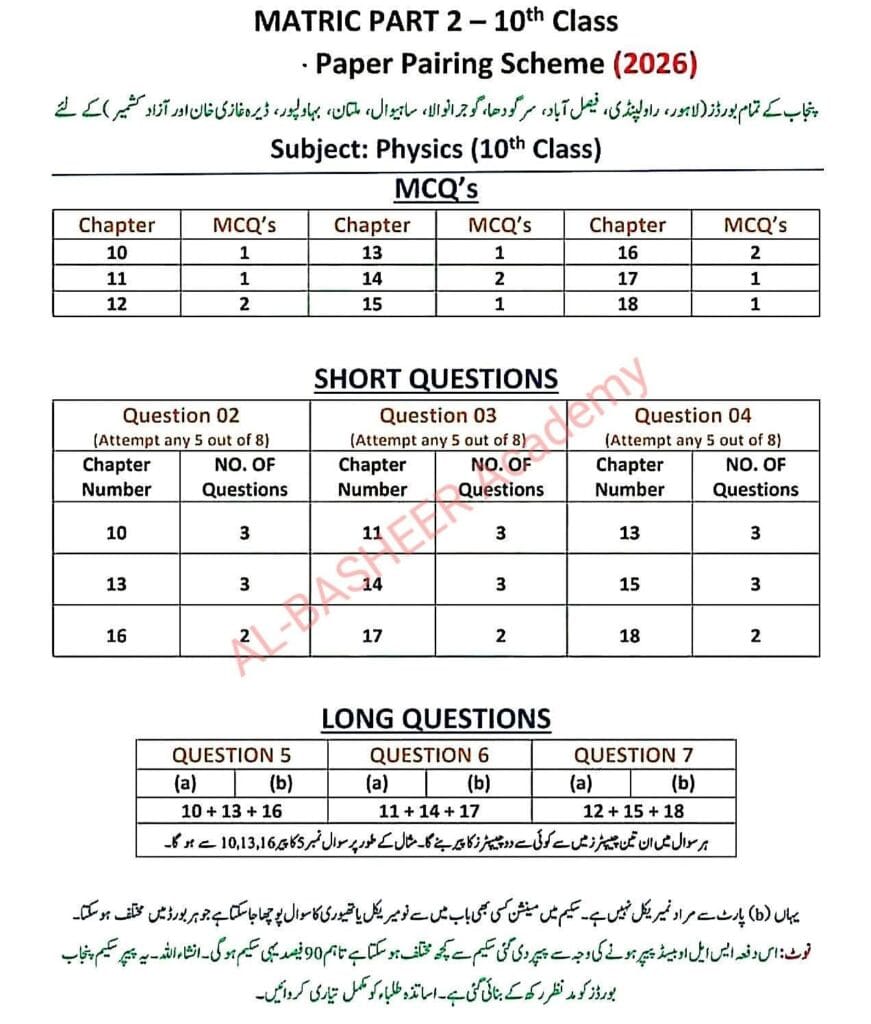
The Physics Class 10 Pairing Scheme 2026 is an essential study guideline for students preparing for board exams. It helps students understand how objective, short questions, and long questions are distributed from different chapters. By following the latest pairing scheme, students can focus on important topics and improve their exam performance with smart preparation instead of random study.
The 10th class Physics pairing scheme 2026 is especially useful for identifying chapter combinations that are likely to appear together in the paper. Students who review the pairing pattern regularly can better manage their revision time and strengthen high-weightage topics in Physics.
For those searching for the pairing scheme 2026 of 10th Class, it provides a clear roadmap of question patterns based on board exam trends. This makes preparation more organized, helping students reduce stress and increase accuracy during exams.
Other Subjects Class 10 Pairing Schemes:
Importance of 10th Class Physics Pairing Scheme 2026
The 10th class Physics pairing scheme 2026 plays a major role in exam preparation because it saves time and improves focus. Instead of studying every topic equally, students can give more attention to high-weightage chapters.
It also helps students understand the structure of the paper, which reduces confusion during the exam. When students are familiar with the pairing system, they can attempt questions more confidently and manage time more effectively.
Another important benefit is better revision planning. Students can revise paired chapters together, which strengthens concept clarity and improves retention of formulas and laws in Physics.
How Physics Paper Pairing Scheme 2026 Class 10 Helps in Preparation
The Physics paper pairing scheme 2026 Class 10 is highly useful for building a smart study strategy. It allows students to divide chapters into manageable sections and prepare them according to exam importance.
By understanding the pairing pattern, students can practice past paper questions in a more targeted way. This improves problem-solving speed, especially in numerical-based chapters like motion, work and energy, and electricity.
Teachers also recommend using the pairing scheme for revision because it aligns with board paper trends and helps students focus on frequently tested concepts.
Chapter-Wise Focus in Physics Class 10 Pairing Scheme 2026
The Physics Class 10 pairing scheme 2026 usually highlights important chapters that are frequently combined in exam papers. These include topics that involve numerical problems, conceptual understanding, and short definitions.
Chapters like Electrostatics, Current Electricity, Magnetism, and Simple Harmonic Motion are often considered high-priority because they regularly appear in different question formats.
At the same time, theoretical chapters such as Atomic Structure and Nuclear Physics are also important for short questions and definitions. Understanding how these chapters are grouped helps students plan balanced preparation.
Smart Study Strategy Using Physics Pairing Scheme 2026
Students preparing for board exams can improve their performance by following a structured approach based on the Physics Class 10 pairing scheme 2026. One effective method is to study paired chapters together instead of random revision.
Practicing numericals daily is also important because most pairing schemes include at least one numerical-based section in long questions. This improves accuracy and speed in solving Physics problems.
Another useful strategy is to revise definitions, formulas, and laws repeatedly, as they are commonly tested in short question sections. This helps in scoring easy marks in the exam.
Benefits of Following 10th Class Physics Pairing Scheme 2026
The 10th class Physics pairing scheme 2026 offers several academic advantages for students preparing for board exams. It reduces unnecessary study pressure by clearly showing which chapters are more important.
It also improves exam confidence because students already know the paper structure and question distribution. This helps them attempt the paper in a more organized way.
Additionally, it supports better time management during preparation, allowing students to focus more on weak areas while strengthening strong topics effectively.